This is a celebration of bars and the drinking experience. Telling the life and times of pubs, bars, hotels, clubs,restaurants and any other establishments that purvey liquor in Glasgow and beyond. Free from any traditional review structures, here you will find a unique, independent collection of articles, essays, updates, anecdotes and observations from the imbiber’s point of view.
Any comments on the blog, propositions (legal, of course), ideas for places for me to go see, please get in touch at thebarbiographer@hotmail.com and don't forget to follow me on TwitterFollow @barbiographer
Friday, 11 January 2013
Onwards
It could hardly have been a worse year for the bar business than 2012 (though I daresay the future may prove me far wrong) so I’d like to look ahead as opposed to reversing time. In contrast to what has gone before maybe 2013 will see more pubs opening than closing; proper government support for the local; bars at last seen as the solution to not the cause of social problems and a trade in general on the rise rather than decline.
But on to specific (and more realistic) wishes –
THE OLD RE-EMERGING
Many Glasgow addresses used to be bars. How good it would be to have even a fraction of these returned to their original uses especially in under-provisioned locales. The East End, for instance, has been stripped bare of its pubs. Will the Commonwealth Games prove to be any sort of catalyst for a bar renewal?
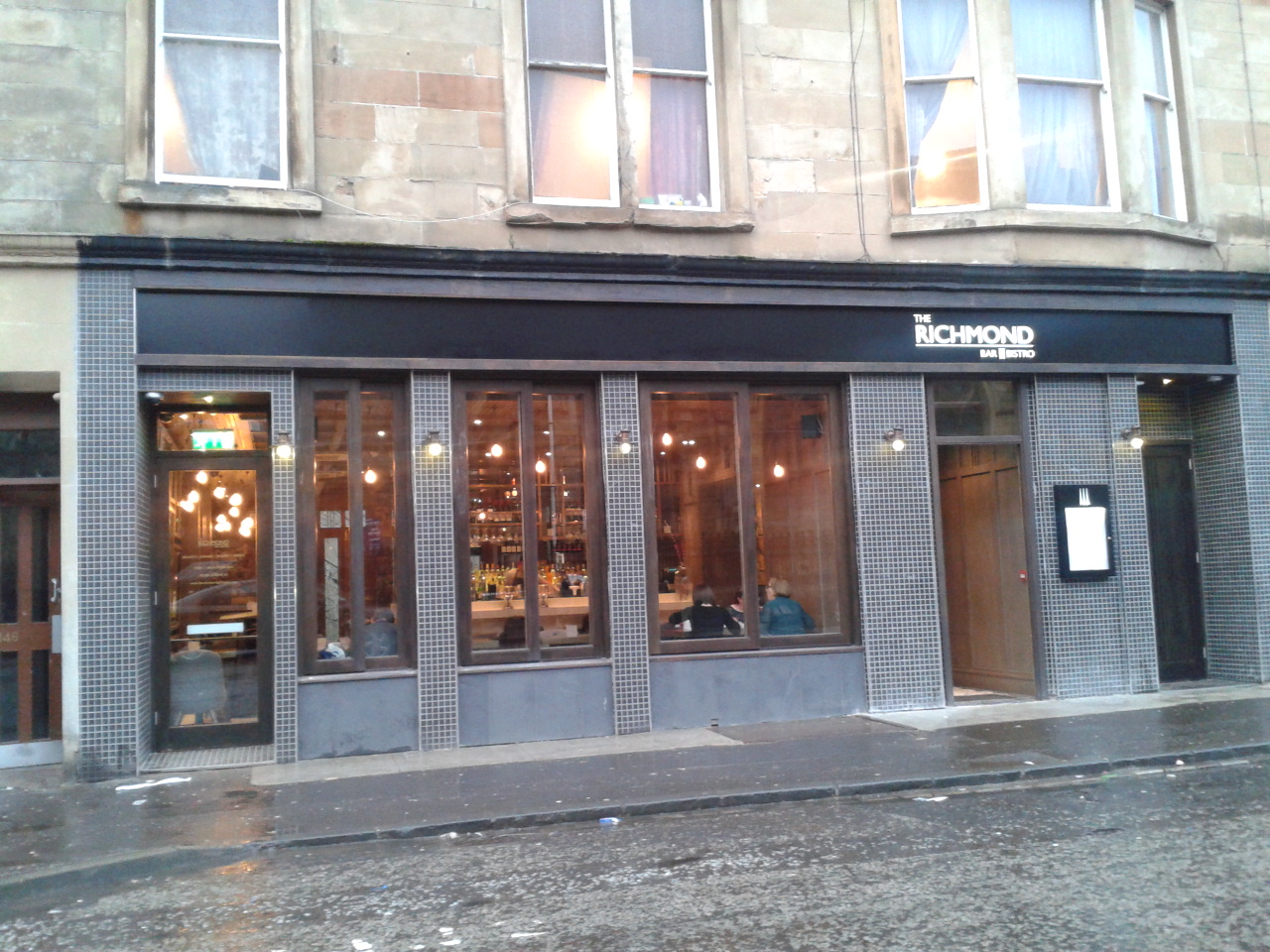
A good sign is the recent openings of The Richmond (formerly Bar Bola and before that The Blythswood Cottage), The Sparkle Horse (The Dowanhill) and The Kelvingrove Café (Kelvingrove Café). I’ll be reviewing these in future blogs.
FOOD AND DRINK IN PERFECT HARMONY
Our tradition in Britain has been to separate these two hospitality elements with rigid distinctions between restaurants and bars. Although these divides have blurred recently it is still unusual for drinkers to enter and use a ‘restaurant’s’ bar without buying any food as it is for bar-goers to expect decent snacks along with their beer.
Flexibility and choice is the key to allow customers to mix and match drinks and food on a casual and cheap basis. That’s why places like Panevino and Edinburgh’s Divino Enoteca are welcome additions to the recent scene with accompanying innovations like an extended range of wines by the glass, whisky flytes and mini-platters of cheese, honey, relishes, hams etc
RIVER CITY
Imaginative designs and locations are as important as food and drink ranges so hopefully some exciting new ventures will be dreamed up, developed and allowed planning. A start could be more venues on the riversides to build on stalled developments and bring to fruition GCC’s aim of shifting the city’s focus to the Clyde.
We also need better outdoor provision so news that the forthcoming bar, Hyde, at the corner of Byres Road and Dumbarton Road is incorporating a south-facing terrace is welcome. And, I hope, interesting ventures such as the transformation of a public convenience at Anniesland Cross into a tapas joint can get the financial backing they need.
GET OUT MORE
With my bar count approaching 500 for Glasgow, and well into three figures for Edinburgh, I intend to experience far more pubs elsewhere in Scotland and beyond.
And just get out more in general because, for me, going out is – aside from The Muse and Logan – what makes life worth living.
LIFELONG AMBITION
Unless I receive an unexpected inheritance it won’t happen this year but some time I do want to set up my own bar in Glasgow’s most atmospheric street, Parnie Street. Some great little den that will last for at least two centuries and its good times be talked about for even longer.
Talking of places 200 years old, the Old College Bar on High Street is under threat of demolition. Glasgow’s oldest (circa 1815) has fallen into serious disrepair but deserves to remain for the sake of the city’s heritage. I intend to oppose its demise strongly.
Monday, 10 December 2012
Linthouse - The Vital Spark & The Gazelle
The Vital Spark, 1155 Govan Road, Glasgow G51
The Gazelle, 1213 Govan Road, Glasgow G51
This is what I love to do. Forget the pubs everyone knows about and hunt the bars that rarely feature in any guide, online or otherwise. All pubs need custom, some more than others and I’m always in favour of redistribution.
Linthouse is at the dark end of Govan; most non-locals will only know it as the area into which they emerge after driving southbound through the Clyde Tunnel. By dark end I don’t mean the grimmer end, because you can’t get much grimmer than Govan these days, but at the obscure end, G’s little brother.
As such you would expect some dark little boozers hidden in the back streets but secretive bars hardly exist any more, even here. So both these places sit on the main street, Govan Road. They are only one hundred yards apart but are taking very different routes into the possible future of pubbing for non-city centre urban joints.
The Vital Spark succeeded Fairfield’s a few years ago. The former place was quite well known and its presence is still apparent on Google Maps. The new(ish) name may be a nod to the famous shipbuilding tradition round here. Incidentally, that tradition, fragile as it is now may even be broken entirely if BAE Systems choose their Govan yard as the one of three to close.
Just how many shipworkers use the Vital Spark is unknown but it is a welcoming place despite having only one window. I would guess the original interior is long gone and in its place is a slice of suburban clubland. Plenty of cream, sofas, fairy lights, mirrors and soft furnishings scattered throughout.
It’s as if a whole street of neighbours got together and placed their various pieces of cut-price bling into one big room. Sounds rather naff but it isn’t. It has a genuine warmth and inclusiveness and accompanying the pooling of furniture and fittings are the neighbours themselves.
Couples – young, middle-aged and older – along with singles of both gender come in every day of the week to support the place. And the way they chat to each other and the bar staff it appears like this is a community effort, a venue they all have a stake in.
Fanciful? Perhaps just an over-optimistic appraisal but when one sits there at 6pm on a winter Wednesday and the music throbs out one could believe anything.
West along the main road to The Gazelle and things appear very different. The small high windows only reveal a harsh light similar to the kind of lighting you get in gent’s conveniences. Not a good start. But this forbidding frontage is worth penetrating.
Inside, is one of the cleanest pubs I have sat in (forgive the pun). Every surface shines and that includes the wooden floor which would be an envy of any home. The only rival to this level of cleanliness is the District Bar on Paisley Road West at the other end of Govan Road.
And underneath the impressive glass and dark wood gantry, mixer bottles are arranged in incredibly neat rows, this reminiscent of the tidy bar work you find at The Laurieston. The striped two-tone banquettes make for comfortable and stylish seating and even those windows are complimented with high quality roller blinds.
You can sit and enjoy The Govan Press on those banquettes or at the bar on a high stool while other single drinkers accompany their dog while it sips from its own shiny bowl. The Gazelle nods towards other aspects of pub life with karaoke and quiz nights, and satellite football but this kind of conviviality is its speciality.
To the left of the main bar is a lounge decorated in scarlet and cream (looks better than it sounds) and this could be a great wee place for more private chats or modest functions.
The Gazelle was previously the well-renowned Stuart’s restaurant of 1960s vintage. Back then, the rage wasn’t for floor-to-ceiling windows, so you can get misunderstandings today about joints and their true nature when so little of the interior can be seen from the street.
This is a leased tenancy – the present occupant only there a couple of months – and this leaves it at a further disadvantage from free houses like The Vital Spark, in terms of flexibility, breathing space and a sustainable profit. But, regardless of type of ownership both these bars will struggle for at least the next decade.
You don’t have to think about any of these things to visit either of these bars. Just do it. And help those less fortunate. After all, it is the season for it.
Tuesday, 6 November 2012
Panevino
Panevino, 1075 Argyle Street, Glasgow G3 8LZ
The Finnieston, 1125 Argyle Street, Glasgow G3
I’ve said it before and I’ll do so again; Finnieston’s stretch of Argyle Street is the area setting the pace in Glasgow bar nightlife. Every few months something new appears. Not just new premises but a fresh concept. A recent outing for The Muse and I confirmed this.
The latest joint, Panevino, was one of our planned destinations. But before that we returned again to The Finnieston, a place I reviewed last year. It continues to trade well and for all the right reasons. Pleasing ambience, serious bartending and fresh seafood all impress. And, I believe, one of their staff, Dean Evans received a commendation for mixology at the recent SLTN Awards.
Any bar that deploys decanters and serves absinthe will sit high on my top list and shows commitment to decent booze and correct serving of liquor. They hand you a large esoteric menu of their latest cocktail specialities and I picked an Abisette (absinthe etc etc etc) while The Muse opted for the litmus test that is a Bloody Mary. Mine reminded me of a Vodka Martini for sheer alcoholic potency. Enjoyable but portentous. The BM, meanwhile, was spicy and tangy, the boxes that need ticking.
Panevino is just a hundred yards along Argyle Street and sits in a small unit beneath flats built on the site of the massive Crème de la Crème Indian restaurant - itself having inhabited an old cinema. The original intention was, I think, to take the larger corner unit but for some reason this was changed.
The man who would know why is Remo Crolla, owner of the Little Italy pizzeria on Byres Road. Panevino has been his pet project for a few years and present-day Finnieston seemingly the ideal locale in which to realise the plans.
More sophisticated, smoother, sultrier and minimalist than its sister venue this is a place for evening drinks rather than morning or afternoon coffees. It is an enoteca a wine library, and browsing is certainly allowed. There are over 50 available by the glass, dispensed from their very expensive glass gantry. Nice for those who enjoy variety above all else but can’t afford a new bottle to match every whim.
For even more choice, wine flytes are planned, allowing 50ml samples of wines from areas, grape types, bouquet etc A bit like the whisky flytes available at, amongst other places, Corinthian’s Bootleg bar. Panevino are also stressing their cocktail provision and it’s a place where you can sup on hard to find Italian beers like Ichnusa, Tipopils and Gradisca at least one of which is new to me. I had an Ichnusa which was a bit too weak for me but The Muse was happy with her particular choice of digestif an Italian brandy.
The joint has two levels, the small upstairs more suited for groups of four to six but for couples or singles downstairs round the U-shaped bar is best. A marbled split-level counter from which to enjoy prosciutto, marinated asparagus, slices of Italian cheese, salami, salsiccella and many other nibbles accompanied by wafer-thin biscuit, beer preserves and honeycomb.
It sounds harmonious and it was. Food and drink complimenting instead of conflicting, as they often do in the UK. Unnecessary distinctions between pubs and restaurants don’t help. What would you call Panevino, for instance? Café/Bar/Restaurant/Wine Bar/Bistro? Maybe enoteca is the closest description, anyway, coming from abroad.
Unfortunately, due to its location Panevino is unable to match the grotto-like beauty of Divino Enotoca’s courtyard setting in the Edinburgh Old Town but then Glasgow venues often suffer in comparison to those of the rival city just because of architectural history. However, a lack of any outdoor component may tell against Panevino come warmer days.
In the meantime there are few more civilised places to sit and enjoy the dual delights of food and drink than at Panevino’s bar. And, pleasantly, this sophistication doesn’t come at a premium because pricing has followed the reasonable rates of Little Italy.
After our modest repast The Muse and I headed out of the district completely because Finnieston still lacks any post midnight joints but despite this gap it remains an area that attracts epicurean, if not yet bacchanalian, followers keen to find the next great thing.
Friday, 28 September 2012
The North Yorkshire Coast - Staithes to Robin Hood's Bay
The Cod & Lobster, High Street, Staithes, North Yorkshire
The Hart Inn, East Row, Sandsend
The Laurel Inn, Bay Bank, Robin Hood's Bay
The Bay Hotel, The Dock, Robin Hood's Bay
When folk are in need we should all do what we can to help. And many people in the North East of England are indeed in need after the recent extreme floods. So, the entire proceeds of this blog, and it may run into hundreds of pennies, will go to whatever disaster fund has the highest profile.
Enough of the munificence, let’s get down to the pubs on this rather famous stretch of cliffs, bays and sand. The village of Staithes appears to have been hewn out of the sandstone cliffs that enclose it. Down a narrow defile, open only to residents’ vehicles, tiny streets branch off into even narrower lanes between modest dwellings.
So compact is the village that you would think the locals are of a smaller breed suited to life here and on the sea. And the harsh, ragged charm of a place long past its seagoing prime would suggest to uninformed but romantic visitors an association with some legendary maritime figure. Guess what, that notion would be correct. Captain James Cook had his first apprenticeship here.
The Cod and Lobster is right on the harbour walls, these boundaries recently re-built, augmenting the already superb natural inlet. The pub’s name promises a better range of seafood than is offered but there are some fish specials to increase the choice. The beer range is better. This is a pub that doesn’t wantonly raise its prices beyond reasonableness. Mainly because of the lack of money in the village and surrounding districts.
The interior is more contemporary than expected with cream walls, leather furniture and blackboards. Despite the nod to modern trends comfort is the aim rather than style. Thus it may well be cosy in winter but in summer the outdoor benches are the place to be round two sides of the building. Great spot even allowing for the strange flies that annoy drinkers. Fishermen amongst you may know if these are fish parasites.
Between Staithes and, the more famous, Whitby is a pleasant coastal journey that can include a stop at Sandsend. This stretch is open in contrast to the coves north and south. Many people enjoy these sands and also, perhaps, the noted high-end restaurant Estbek House and the pub, the Hart Inn.
Both add to the reasons to linger round here by the pretty wooded stream that idles into the North Sea. The pub is welcoming with a decent range of booze and a great beer garden.
Whitby is just down the coast and needs a blog all of its own, that – when I write it – will include Gothic references and ripping sea yarns along with bar experiences, of course.
A smaller place that can be included in this piece is Robin Hood’s Bay. The associations with the renowned outlaw are very dubious but this village doesn’t need them. It is the eastern end of the 192-mile Coast to Coast walk and is a fitting end to this major trek.
A very steep cobbled road is the main artery with many branches leading to all corners of the village. Similar to Staithes, everything is packed tight here. This may have helped during the smuggling heydays of the 17th and 18th centuries. Secret passages and hidey-holes are rife. These, along with the partially subterranean local stream explain why it is believed possible that contraband such as a barrel of rum could be transported from one end of the town to the other without it ever emerging outside.
Nowadays, handling booze isn’t quite so risky or surreptitious - if you ignore the health fascists - and there’s a couple of fascinating wee pubs tucked away, including the Laurel Inn. A tiny hostelry with a bench outside that allows you a prime view of those going up and down the hill to the sea.
At the bottom of the hill the road becomes a slipway into the perpetually cold waters of the North Sea. Happily, there’s a bar down there – the Bay Hotel - to afford a full appreciation of the setting. The actual bar interior is a tad disappointing; too much faded carpet that seems to date from the last refurb in the 1980s.
It’s normally busy though so maybe the owners don’t feel more investment in the place is worth it. A pity but with a terrace like this one, less important than it might have been. Wrap up if you have to, to enjoy it or the other outdoor area to the side by the road. Either spot is good to watch the waves pound the bay whether at low or high tide. Sit, or stand, and observe the wild power of nature. North Easterners fully appreciate that power this week.
Labels:
Bay.Hotel,
Cod.and.Loster,
Hart.Inn,
Laurel.Inn,
North.Yorkshire,
Robin.Hoods.Bay,
Sandsend,
Staithes
Wednesday, 5 September 2012
Tranquil Banks
Inn Deep, 445 Great Western Road, Kelvinbridge, Glasgow
The Ferry, 25 Anderston Quay, Glasgow G3 8BX
Lock 27, 1100 Crow Road, Glasgow G13 1XX
The Ferry Inn, 1 Clyde Street, Renfrew PA4 8SL
The Glen Lusset, 67 Dumbarton Road, Old Kilpatrick, G60 5DA
The imminent opening of Inn Beer – 07/09 – in the former Big Blue pushed me into thinking about Glasgow’s provision of watering holes by the, err, water.
Inn Beer will be joining a limited selection of bars that not only are situated near river or canal but actually allow you to appreciate your lucky location. The new bar is to offer craft beer, great cocktails, good grub and fun times. Let’s hope it can make this formula work where others, such as Bruadar, have recently failed.
Its location is certainly a winner. Built into an old railway arch under Kelvinbridge with glass doors opening on to the Kelvin walkway, tables are as close to the river as is legal. Other nearby arches have been utilised for raves and other subterranean shenanigans but that was some years back when this space attracted more custom.
Maybe it was greater competition from pubs and cafes up on street level either on Great Western Road or Gibson Street that led to Big Blue’s demise, a lack of marketing presence to help draw folk down the two levels to the bar – a sandwich board on the street isn’t enough these days – or the fact that on sunny days there was never enough outside seats to keep everyone happy.
If we have a successful newcomer here perhaps other sites will become available by water to add to the small number of licensed premises at present. I know it is the council’s intention to utilise Clydeside further, drawing the city centre in that direction, so they should put their planning where their mouth is.
Just now, the only place for a casual drink Clydeside central is the City Café near the SECC, part of the Hilton Garden Inn, whose management have imaginatively deployed an elegant pontoon.
Going east, The Ferry – the actual old Yoker to Renfrew ferry boat – continues to provide various eclectic club nights, maintaining a tradition dating from the 80s and 90s with stalwarts such as Panama Jacks and the floating fun palace - complete with hundreds of pairs of white stilettos and rejects from Miami Vice - that was Tuxedo Princess.
Six miles downstream there was a straightforward boozer on the riverbank. The Wharf in Yoker sat adjacent to the jetty of the aforementioned ferry. Attracting a devoted clientele, strangers got their fair share of local wit but all in the best taste. The Wharf had limited space but this mostly added to the jocularity.
One of the regular fixtures around the island bar added to the fun with his stoic insistence that he was a member of the Glencoe Mountain Rescue Team. This despite the fact he lived around 80 miles from their base and was drunk 16 hours out of every 24. His fantasy was truly burst one evening when another punter arranged a call to come in from an actual member of the team. On speaker phone to a packed pub he confirmed he nor anyone other team member knew of our delusional friend.
Sometime around the Millennium the dreaded box of matches struck (allegedly) and the place succumbed to fierce flames. Whoever benefited from the conflagration it wasn’t Yoker socialisers.
Directly cross-river and now only joined by a basic passenger ferry is the aptly named Ferry Inn of Renfrew.
The building reputedly dates from the early 18th century and unsurprisingly the interior is a little rough around the margins but details such as window seats and extensive use of dark wood mean the place gains more from its age and tradition than it loses.
The inn is a good enough destination all on its own but it can also serve as either the beginning or end of a crawl through the old town of Renfrew.
As for canals there is also limited choice inside the Glasgow environs. I’ve spoken about Lock 27 before but it is the only Glasgow bar that sits by a towpath. It continues to do respectable business especially during hot summers – if those ever return in this lifetime.
Stables, near Kirkintilloch gets even busier in the heat but is well beyond the city boundary. Another, lesser-known place, that is close to Glasgow is the Glen Lusset in Old Kilpatrick.
Fairly anonymous it may be but it has many features that eclipse the efforts of plenty of places in the city centre. An extensive food counter, raised pool table, conservatory and large beer garden with different levels and nooks all look to have been recent additions.
As well as being right beside the canal, a little stream passes the west side of the garden, the Glasgow to Helensburgh railway line is also close and if that wasn’t enough the huge span of the Erskine Bridge looms above outside drinkers. Quite a spot and made more special by its rarity.
Labels:
city.cafe,
clydeside,
ferry.inn,
glen.lusset,
inn.deep,
kelvinbridge,
lock.27,
river.clyde,
the.ferry
Subscribe to:
Posts (Atom)


